


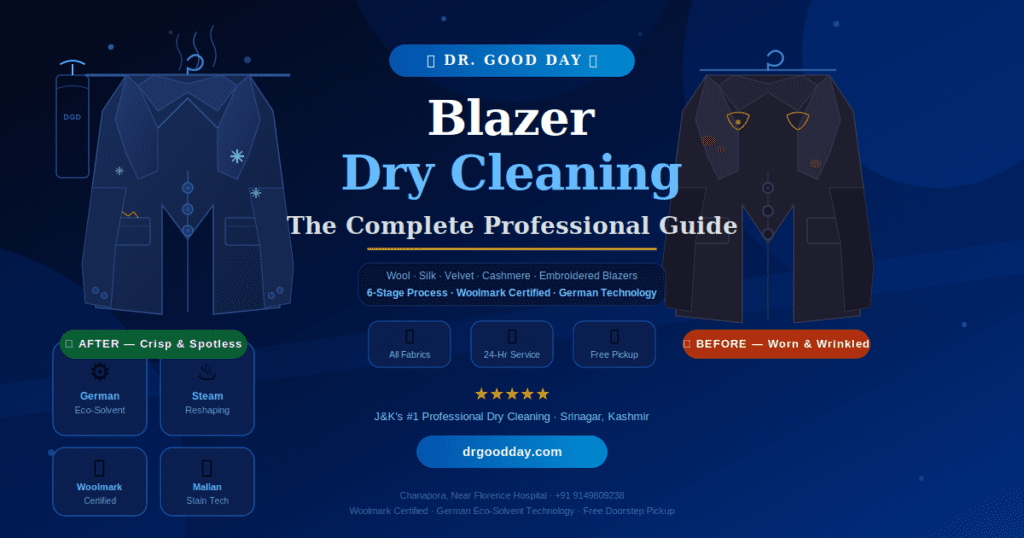
Blazer Dry Cleaning:
Everything You Need to Know
Your blazer is one of the most structured, expensive garments you own. Here's why it deserves nothing less than professional dry cleaning — and how to do it right.
A blazer is not just a piece of clothing — it is a structured investment. Whether it's your daily office blazer, a tailored wool suit jacket, a velvet ceremonial piece, or an embroidered sherwani-style formal, every blazer requires specific care that home washing simply cannot provide. In this guide, we break down everything about professional blazer dry cleaning — fabric by fabric, step by step.
Why You Should Never Machine Wash a Blazer
Most blazers are engineered with internal structure — a canvas lining, shoulder pads, chest interfacing, and carefully sewn seams that give them shape. The moment water and agitation enter the equation, that structure collapses. Here's exactly what goes wrong when you machine-wash or hand-wash a blazer:
Loss of Shape
The internal canvas and interfacing warp permanently when wet. Shoulders collapse, lapels curl, and chest loses its clean line — irreversible without expensive re-tailoring.
Colour Fading & Bleeding
Woven blazer fabrics — especially wool, velvet, and blended materials — bleed colour unpredictably in water. Even cold water can dull that sharp navy or charcoal finish.
Fibre Damage
Wool and silk fibres swell in water and become tangled under agitation. This causes pilling, shrinkage, and a rough, matted texture that cannot be restored at home.
Lining Separation
The lining of most blazers shrinks at a different rate than the outer fabric. Wet washing causes the lining to pull, pucker, or detach from seams — destroying the garment's fall.
Embellishment Damage
Buttons, embroidery, sequins, beading, and decorative stitching can discolour, loosen, or fully detach when exposed to water and detergent agitation.
Distorted Drape
Even if the blazer appears intact after washing, its drape — how it falls and moves — is permanently altered. It will never hang the same way again without professional reshaping.
💡 Expert Rule
If your blazer label says "Dry Clean Only" — that's a manufacturer directive, not a suggestion. Ignoring it will void any tailor's warranty and often destroy the garment permanently. When in doubt, always dry clean.
Blazer Fabric Types — Which Needs What
Not all blazers are equal. The cleaning method must match the fabric composition. Here's a complete breakdown of every common blazer fabric and how it should be treated:
| Fabric Type | Dry Clean? | Home Wash? | Special Notes |
|---|---|---|---|
| Wool / Tweed | ✔ Essential | ✘ Never | Shrinks, felts, and warps in water. Steam finishing required after dry clean. |
| Silk / Silk Blend | ✔ Essential | ✘ Never | Extremely water-sensitive. Water stains silk permanently. Solvent-only cleaning. |
| Velvet | ✔ Essential | ✘ Never | Pile flattens and discolours with water. Requires specialist velvet revival treatment. |
| Linen | ✔ Recommended | ⚠ With care | Can be hand-washed cold but loses shape. Professional blocking recommended after. |
| Polyester / Synthetic | ⚠ Recommended | ⚠ Possible | Check lining — even if outer fabric is polyester, wool or silk lining requires dry clean. |
| Cotton | ⚠ Recommended | ⚠ Possible | Structured cotton blazers still lose shape in machine wash. Hand wash only, professional press essential. |
| Cashmere / Pashmina Blend | ✔ Essential | ✘ Never | Woolmark certification required. Ultra-fine fibres need solvent cleaning and cool-air drying. |
| Embroidered (Aari/Tilla) | ✔ Essential | ✘ Never | Thread bleed risk is extremely high. Requires pre-treatment before solvent cleaning. |
How Professional Blazer Dry Cleaning Works — Step by Step
At Dr. Good Day, every blazer goes through our rigorous 6-stage professional process. Here's exactly what happens from the moment we receive your garment:
Inspection & Tagging
Each blazer is inspected under good lighting for stains, loose threads, missing buttons, and care label instructions. A unique tag is attached to track the garment through every stage. Any special instructions are noted — embroidery placement, bead fragility, pocket contents removed.
Pre-Stain Treatment (Mallan Technique)
Visible stains — oil, food, sweat collars, makeup — are treated individually using our proprietary Mallan stain-removal technique before the garment enters the main cleaning cycle. Different stain types require different solvents; we select and apply precisely.
German Eco-Solvent Dry Cleaning Cycle
The blazer enters our German eco-friendly dry cleaning machine. Instead of water, a specialised eco-solvent permeates every fibre, dissolving oils, odours, and dirt without disturbing the fabric structure, lining, canvas, or embellishments. The solvent is then extracted and filtered for reuse — zero water waste.
Post-Clean Inspection
After the cleaning cycle, the blazer is re-inspected. Any stains that require a second targeted treatment are addressed at this stage. The lining and outer fabric are checked for consistency — colour, texture, and structural integrity.
Steam Pressing & Reshaping
This is where the transformation happens. Using a professional steam press and garment-form, the blazer is steamed and pressed to restore its original drape, crisp lapels, sharp sleeve lines, and structured shoulders. This cannot be replicated by a home iron — the combination of steam and professional pressure is essential.
Final Quality Check & Protective Packaging
The finished blazer is inspected one final time — every button, seam, lapel, and pocket — before being placed on a padded hanger, covered with a breathable garment bag, and tagged for delivery. A WhatsApp photo confirmation is sent before dispatch.
"A blazer pressed on a professional steam-form looks fundamentally different to one ironed at home. The shoulder, lapel, and chest panel all behave differently — that precision is what clients pay for."
— Dr. Good Day Garment Care SpecialistHow Often Should You Dry Clean Your Blazer?
Over-cleaning is as harmful as under-cleaning. Each dry cleaning cycle, however gentle, subjects fibres to chemical exposure. The right frequency depends on how you use your blazer:
🧠 Between Cleans
Between dry cleaning sessions: hang your blazer on a broad, padded hanger. Brush off surface dust with a clothes brush. Air it overnight after wearing. Spot-treat minor marks with a dry cloth. Steam lightly if it wrinkles. These habits extend the time between professional cleans significantly.
Reading Your Blazer's Care Label
Every blazer carries a care label with internationally standardised symbols. Here's how to decode the most important ones before you hand over your garment anywhere:
Dry Clean Only
Circle symbol. Must not be washed with water under any circumstance. Professional solvent cleaning only.
Do Not Dry Clean
Circle with an X. Rare on blazers — means solvents will damage this fabric. Requires specialist wet cleaning.
Steam Permitted
Steam iron symbol. Allows professional steam pressing — essential for restoring blazer shape after cleaning.
Low Temp Only
Single dot on iron symbol. Delicate fabric — requires cool iron or low-heat steam only to avoid scorch marks.
Do Not Wring
Twisted fabric symbol with X. Never wring or compress the blazer — distorts seams, lining, and shoulder structure.
Woolmark Certified
Wool or Woolmark logo. Requires Woolmark-certified processing — Dr. Good Day is certified for all wool blazers.
Do's and Don'ts of Blazer Care
Whether at home between cleans or when choosing a service, these rules will protect your blazer's life and appearance:
✅ DO These Things
- Always hang on a wide, padded hanger
- Brush surface lint and dust after wearing
- Air blazer for 30 min before storing
- Use a breathable garment cover for storage
- Spot-treat stains immediately with a dry cloth
- Dry clean before seasonal long-term storage
- Ask your cleaner about fabric-specific treatment
- Unbutton before hanging to relieve seam pressure
- Use cedar blocks — not mothballs — for wool blazers
❌ DON'T Do These
- Never machine wash any structured blazer
- Never soak in water — even briefly
- Don't use wire hangers — they distort shoulders
- Don't compress or fold for long storage
- Don't iron directly — always use a pressing cloth
- Don't ignore care label instructions
- Never store while damp — causes mould in fibres
- Don't over-dry clean — it weakens fibres over time
- Never use home spray starch on wool or silk
Special Blazers That Need Extra Care
🧥 Wool & Tweed Blazers
Kashmir's cold climate means wool blazers are wardrobe staples here. Tweed, pure wool, and wool-blend blazers must be dry cleaned using Woolmark-certified processes — a standard Dr. Good Day holds. These fabrics are highly sensitive to heat and moisture, and improper cleaning will felt (permanently mat) the fibres irreversibly.
👑 Embroidered & Ceremonial Blazers
Wedding sherwanis, bandhgala jackets, and embroidered blazers with Aari, Tilla or Zardozi work require pre-treatment of the embroidery area before the solvent cycle. Thread types — metallic, silk, cotton — each react differently to solvents, and our team accounts for each individually.
🖤 Velvet Blazers
Velvet is arguably the most fragile blazer fabric. The pile — the raised, soft surface that gives velvet its texture — crushes permanently under pressure and discolours with any moisture contact. Velvet blazers require a dedicated velvet-revival steam treatment after cleaning to restore the pile direction and lustre.
🥻 Bandhgala & Nehru Collar Jackets
These structured Indian formal jackets feature unusually rigid collar and front placket interfacing. The collar must be pressed over a specialised rounded form — not a flat press — to maintain its characteristic stand collar shape. This is standard procedure at Dr. Good Day for all Nehru jacket variants.
What to Check When Choosing a Blazer Dry Cleaner
Not all dry cleaners are equipped for structured garments like blazers. Before handing over your blazer, verify these non-negotiables:
- They ask about your fabric type and check the care label before accepting
- They have a dedicated pressing form or garment-former (not just a flat iron)
- They use genuine dry cleaning solvents — not just steam or wet cleaning
- They are Woolmark-certified for wool and Pashmina blazers
- They provide a garment receipt and inventory tag
- They have a clear policy for damage or stain reoccurrence
- They use breathable garment bags — not plastic — for packaging
- They offer WhatsApp tracking or updates during the process
Frequently Asked Questions — Blazer Dry Cleaning
❓ How long does blazer dry cleaning take at Dr. Good Day?
Standard blazer dry cleaning is typically completed in 24 hours. For express service, we offer 8–12 hour turnaround on most blazer types. Heavily embroidered or embellished garments may require 36–48 hours to ensure proper pre-treatment and pressing. We'll always confirm your timeline at pickup.
❓ Can you remove sweat stains from blazer collars and underarms?
Yes — underarm and collar sweat staining is one of the most common issues we handle. Our Mallan pre-treatment technique specifically targets protein-based stains (like sweat and body oil) before the dry cleaning cycle. Older, set-in stains may require a second treatment. Results depend on how long the stain has been present and the fabric type.
❓ My blazer has lost its shape — can dry cleaning fix it?
If the shape loss is due to improper storage or temporary distortion, professional steam pressing and reshaping on our garment-form can absolutely restore it. If the internal canvas or interfacing has been damaged (usually from previous wet washing), we will assess and advise accordingly — some structural repairs require re-tailoring.
❓ Do you dry clean wedding sherwanis and embroidered blazers?
Absolutely — this is one of our specialties. We handle embroidered sherwanis, bandhgala jackets, Nehru collar pieces, and ceremonial formal wear with dedicated pre-treatment protocols for different embroidery types including Aari, Tilla (zari), Sozni, and Zardozi. Please mention embroidery details when booking so we can prepare appropriately.
❓ Do you offer pickup and delivery for blazer dry cleaning?
Yes — free doorstep pickup and delivery is available across Srinagar including Chanapora, Humhama, Nowgam, Soura, Maloora, and HMT. Simply WhatsApp us at +91 9149809238 or schedule a pickup online. We treat every garment like our own.
❓ How much does blazer dry cleaning cost at Dr. Good Day?
Our pricing is transparent and listed on our pricing page at drgoodday.com/pricing. Blazer dry cleaning is priced per garment based on fabric type and complexity. Embroidered or embellished blazers are priced slightly higher due to the additional pre-treatment required. No hidden charges — ever.
The Bottom Line: Your Blazer Deserves Professional Care
A blazer is a precision garment — engineered to look sharp, maintain structure, and make an impression. Treating it with anything less than professional dry cleaning is a gamble with an investment you've made in your appearance and your wardrobe.
At Dr. Good Day, we treat every blazer — from a ₹3,000 office jacket to a ₹50,000 embroidered sherwani — with the same level of professional attention: Mallan pre-treatment, German eco-solvent cleaning, Woolmark-certified processes, and steam pressing on a professional garment-form. The result is a blazer that looks, fits, and feels exactly as it should.
Your Blazer Cleaned, Pressed & Delivered — In 24 Hours
Free doorstep pickup across Srinagar. Woolmark-certified. German eco-technology. 6-stage cleaning process. WhatsApp us to book your blazer dry cleaning today.
Dr. Good Day Editorial Team
Expert fabric care guides from J&K's first indigenous professional dry cleaning chain — Woolmark-certified, German-technology powered, and proudly serving Kashmir's communities from our studio in Chanapora, Near Florence Hospital, Srinagar.