


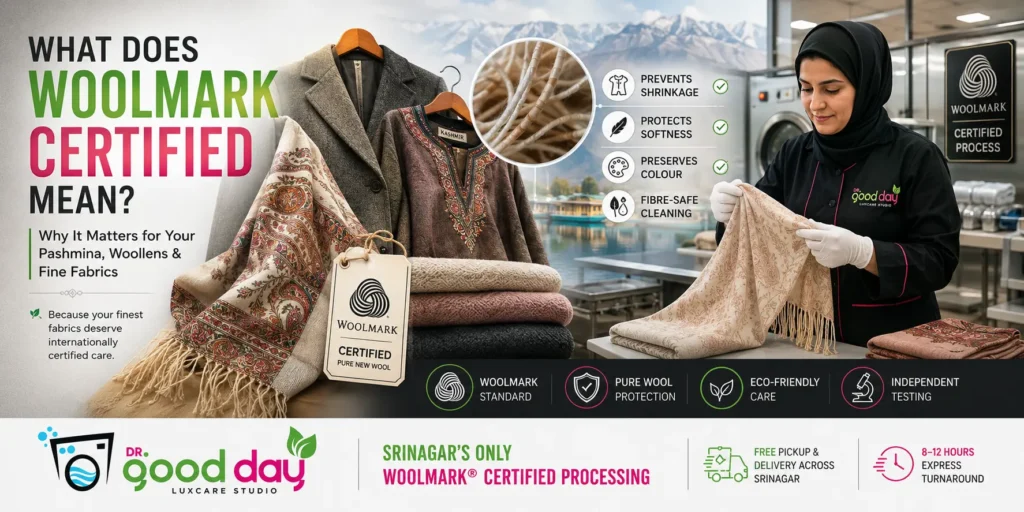
What Does Woolmark Certified Mean — and Why It Matters for Your Clothes
You’ve seen the small ball-of-yarn symbol on your favourite woollen jacket or Pashmina shawl. But what does it actually mean — and should you trust any dry cleaner to handle it? This guide explains Woolmark Certified from the ground up, in plain language.
Kashmir is one of the few places on earth where people wear and live in genuinely precious wool — Pashmina shawls, hand-loomed pherans, fine woollen suits, and heirloom carpets. For these fabrics, the difference between a Woolmark Certified cleaning process and a regular one is the difference between a garment that lasts 20 years and one that shrinks, pills, or loses colour after a single wash.
At Dr. Good Day Luxcare Studio, we are Srinagar’s only dry cleaning studio using Woolmark Certified processing for woollens and Pashmina. Here’s exactly what that means for you.
What Is the Woolmark Symbol?
The Woolmark symbol — three interlocking triangles forming a ball of yarn — is the world’s most recognised textile quality mark. It was created in 1964 by the International Wool Secretariat (now The Woolmark Company) and is owned by Australian Wool Innovation Limited.
When a product or a service carries the Woolmark certification, it has passed independent laboratory testing against strict global standards for:
- Fabric purity (100% pure new wool or specified wool content)
- Durability and resistance to pilling
- Colour fastness under washing and light
- Dimensional stability (the fabric must not shrink or stretch beyond defined limits)
- Seam and tensile strength
The Three Woolmark Labels — What Each One Means
Not all Woolmark labels are identical. There are three variants, and knowing which one is on your garment tells you a lot about its composition:
| Label | Wool Content | What It Means for Care |
|---|---|---|
| Woolmark (pure) | 100% new wool | Requires the most delicate cleaning — no machine wash, no heat |
| Woolmark Blend | 55–99% new wool | Slightly more tolerant, but still needs specialist care |
| Wool Blend | 30–54% new wool | Can handle gentle machine cycles, but dry cleaning recommended |
Kashmir-specific note: Authentic Pashmina (fine Cashmere from Changthangi goats) almost always falls under the pure Woolmark category. Even garments labelled “Pashmina blend” can carry Woolmark Blend certification if the wool content is verified. Always check both labels.
Why Woolmark Certified Cleaning Actually Matters
Here’s the part most people miss: the Woolmark symbol can appear on cleaning products and cleaning services — not just garments. A dry cleaner that holds Woolmark certification for its cleaning process has been independently tested to prove their solvents, temperatures, agitation levels, and finishing techniques do not damage certified wool fabrics.
What happens when wool is cleaned incorrectly?
Wool fibre is covered in microscopic scales. When exposed to wrong temperatures, harsh chemicals, or excessive agitation, those scales interlock — causing irreversible felting and shrinkage. You’ve probably seen a favourite jumper come back from the laundry looking like it fits a child. That’s felting. It cannot be undone.
- Hot water opens the scales and causes matting and shrinkage
- Alkaline detergents (most household detergents) strip natural lanolin from wool fibres, causing brittleness
- High-spin tumble drying causes felting in under three minutes
- Incorrect pressing temperature flattens the fibre’s natural crimp, permanently removing softness
- Wrong solvents in dry cleaning cause colour bleed and fibre damage in fine Pashmina
What Woolmark Certified processing guarantees
- pH-balanced solvents — only cleaning agents that maintain the natural pH of wool (4.5–6.0) are used, preserving lanolin and softness.
- Temperature-controlled environment — wool must never exceed 40°C at any stage of wet processing. Our German machinery controls this to ±1°C precision.
- Low-agitation cycles — proprietary low-tumble drum settings that mimic the gentle movement of hand-washing at scale.
- Fibre-safe finishing — steam pressing at controlled humidity prevents shine marks and restores natural loft to the fabric.
- Dimensional control — garments are blocked to their original dimensions during drying to prevent any shrinkage or stretching.
Woolmark Certification and Pashmina: A Special Relationship
Pashmina is not just any wool — it is fine cashmere harvested from the underbelly of Changthangi goats living at 14,000+ feet altitude in Ladakh. The fibre diameter of genuine Pashmina is 12–16 microns (human hair is 70 microns). It is, quite literally, one of the most delicate natural fibres on the planet.
In Srinagar, where Pashmina shawls are heirlooms passed between generations, incorrect cleaning is a genuine tragedy. The Woolmark certified process we use at Dr. Good Day was specifically chosen because:
- It is the only internationally recognised standard for fine wool processing
- It prohibits the use of chlorinated solvents that degrade cashmere micro-fibres
- It requires post-clean inspection against a dimensional standard to confirm no shrinkage has occurred
- It mandates fibre-safe finishing that preserves the characteristic softness and drape of Pashmina
Learn more about our dedicated Pashmina and woollen dry cleaning service and how we handle each piece individually.
How to Check If Your Garment Is Woolmark Certified
Finding the Woolmark label is straightforward once you know where to look:
- Check the inner label — usually sewn at the back collar or inside the waistband. Look for the three-triangle ball-of-yarn symbol alongside care instructions.
- Check the hangtag — on new garments, Woolmark certification is often on a separate hangtag with a licence number you can verify on woolmark.com.
- Look for the wording — “Pure New Wool”, “New Wool”, or “Merino” alongside the symbol confirms the category.
Tip: If your garment says “dry clean only” without specifying a standard, that is a manufacturer instruction — not a quality certification. A dry cleaner holding Woolmark certification operates to a higher standard than “dry clean only” instructions alone require.
Why This Matters Specifically in Srinagar and Kashmir
Srinagar’s climate — cold winters, high humidity in spring and autumn, and dust-heavy summers — creates a unique set of challenges for wool storage and care:
- Humidity encourages mildew growth in stored woolens if not properly cleaned before storage
- Kashmiri households typically rotate heavy pherans, shawls, and carpets seasonally — each transition requires professional cleaning
- Wedding and festival seasons demand fast turnaround on heavily embroidered woollen garments (sherwanis, zari-work pherans) that cannot tolerate any deviation in care
- Fine Kashmiri carpets (Namda, Gabroo, hand-knotted pile) contain wool fibres that respond poorly to steam cleaning methods used elsewhere in India
This is exactly why we built our full range of fabric care services around the Woolmark standard rather than conventional dry cleaning practice.
Woolmark Certified vs. Regular Dry Cleaning: A Side-by-Side Comparison
| Factor | Regular Dry Cleaning | Woolmark Certified Processing |
|---|---|---|
| Solvent type | Often PERC (perchloroethylene) — harsh on fine fibres | Fibre-safe, wool-approved solvents only |
| Temperature control | Standard industrial settings | Controlled to ±1°C, never exceeds 40°C for wool |
| Agitation | Standard drum — can cause felting | Low-agitation cycle designed for wool scales |
| Inspection standard | Visual only | Dimensional check against original measurements |
| Finishing | Standard pressing | Steam-only, humidity-controlled, fibre-loft restoration |
| Suitable for Pashmina? | Risk of damage | Yes — independently verified |
How to Care for Woolmark Garments Between Professional Cleans
Storage
- Always store clean — even invisible sweat residue attracts moths and breaks down fibres over time
- Use breathable cotton storage bags, never plastic — plastic traps moisture and encourages mildew
- Add cedar blocks or dried lavender to deter moths without chemical mothball smell that embeds in fine wool
- Store flat or loosely rolled — hanging heavy woollen garments causes shoulder stretching over time
Between wears
- Air your woollen garments for 20–30 minutes after wearing before folding
- Use a wool-specific clothes brush to remove surface lint and refresh the pile
- Allow 24 hours between wears — wool fibres need time to breathe and return to their natural shape
- Spot-treat minor marks immediately with a damp cloth rather than waiting for a full clean
When to bring it in for a professional clean
- Before seasonal storage (before summer for heavy woollens)
- After visible staining — never attempt to remove stains on fine wool at home with household cleaners
- When the garment has lost its natural softness or drape
- After a wedding, event, or extended period of wear
Our dry cleaning and laundry service includes free doorstep pickup across Srinagar with an 8–12 hour express turnaround for most woollen garments.
Frequently Asked Questions
Trust Your Woolens to Srinagar’s Only Woolmark Certified Studio
From your finest Pashmina shawl to your everyday woollen suit — Dr. Good Day Luxcare Studio treats every garment with the precision it deserves. Free pickup and delivery across Srinagar. 8–12 hour express service available.
Explore More from Dr. Good Day
- Dry Cleaning & Laundry Service in Srinagar — our full garment care offering
- Home Fabric Care — carpets, curtains, sofas and more
- Shoe & Bag Cleaning — leather and fabric accessories
- Tailoring & Embroidery — including traditional Kashmiri Aari and Sozni
- Pricing — transparent rates for all services