


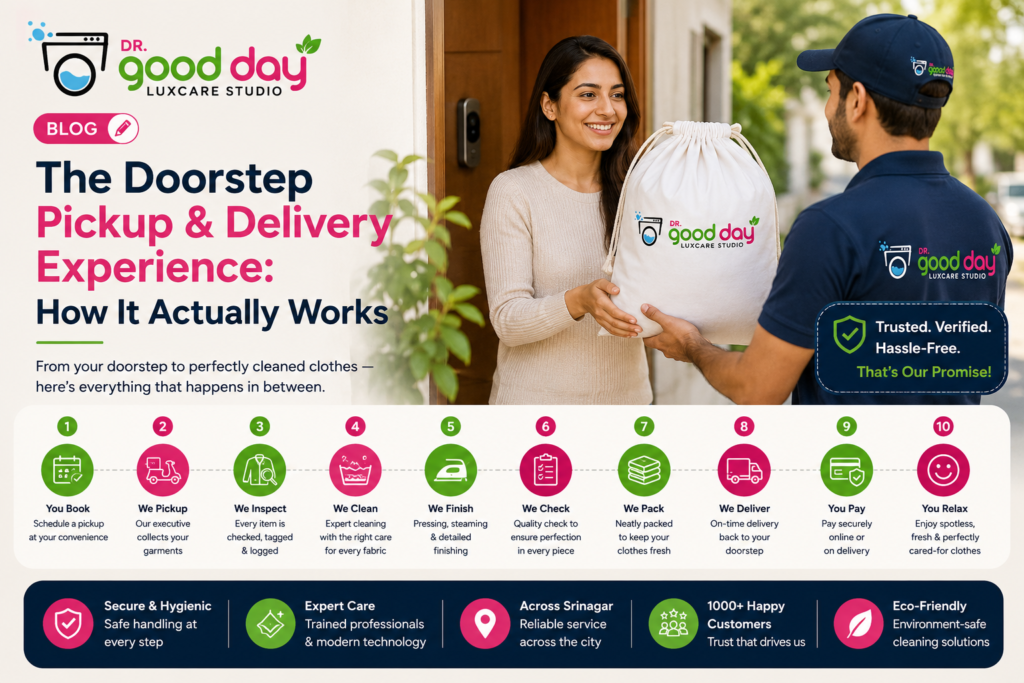
The Doorstep Pickup & Delivery Experience: How It Actually Works
From the moment you book to the moment your clean clothes are back in your hands —
a full walkthrough of what happens in between, and honest answers to the questions
most first-time customers have.
Most people who try doorstep laundry pickup for the first time share the same quiet worry:
“What actually happens to my clothes once they leave my hands?” It’s a fair question. You
hand over garments you can’t watch being cleaned. You trust a stranger to bring them back in
the same — or better — condition. This guide removes that uncertainty entirely. We walk
through every stage of the process, in order, with no skipped steps and no vague marketing
language. By the end, you’ll know exactly what to expect from booking to delivery. You’ll
also know what questions to ask any provider, and how to get the smoothest first experience.
What’s covered in this guide
- Why doorstep pickup exists in the first place
- The full pickup-to-delivery journey, step by step
- Addressing the trust question head-on
- What happens if something is lost or damaged
- Turnaround time, honestly explained
- The technology and process behind the scenes
- Doorstep pickup vs. dropping off yourself
- Who benefits most from doorstep service
- A day in the life of one order
- A second scenario: a bulk seasonal order
- Fewer trips, smaller footprint
- Tips for a smoother first experience
- Common myths, debunked
- How to prepare your garments before pickup
- Hygiene and safety practices
- A note on cost transparency
- Frequently asked questions
Why doorstep pickup exists in the first place
Doorstep laundry and dry cleaning pickup isn’t a gimmick layered on top of an old-fashioned
shopfront. It’s a direct response to how people actually live now. Srinagar, like most
growing cities, has more dual-income households and longer commutes than it did a decade
ago. People simply have less spare time.
Dropping off dry cleaning used to mean carving out thirty minutes mid-workday. You’d drive
to a shop, wait in a queue, then repeat the trip in reverse a few days later. For many
people, that friction was enough to put off cleaning garments that needed it — winter coats
worn one season too long, curtains left uncleaned for years, or a pashmina shawl gathering
dust because a shop visit felt like a chore.
Doorstep service removes that friction entirely. The service comes to you, on your schedule,
instead of the other way around. But a simple idea doesn’t mean simple execution. A provider
has to build a lot of process, tracking, and quality control into the background to make
something feel effortless on your end. That’s what the rest of this guide unpacks.
The full pickup-to-delivery journey, step by step
Here is exactly what happens, in order, from the moment you decide to book to the moment
your order is back in your hands.
You book a pickup slot
Booking happens however is easiest for you — a WhatsApp message, a phone call, or an
online form. You choose a pickup window that fits your day rather than rearranging
your schedule around the service. At this stage, it’s worth mentioning anything
unusual up front: a heavily stained item, a delicate embroidered piece, or a bulk
household order like curtains or a full wardrobe changeover. Flagging this early means
the right specialist and process can be assigned before the order even arrives.
A staff member collects your garments at your door
A uniformed team member arrives within the agreed window. This is the one moment of
direct human contact in the entire process, and it matters — it’s your chance to point
out a stain, mention a loose button, or ask a question in person. You’ll typically
receive a receipt at this point, either printed or sent digitally, listing what was
collected. If you’ve opted for a fully contactless pickup, garments are collected from
a designated spot (your doorstep, building security, or a neighbour by prior
arrangement) and confirmation is sent to your phone instead.
Every item is inspected, tagged, and logged
This is the step most customers never see, and it’s the one that matters most for
trust. Each garment is individually inspected before anything else happens. Existing
damage — a small tear, a loose seam, a faded patch — is noted and, where possible,
photographed. This protects you and the service equally: it means nothing gets blamed
on the cleaning process that was already there beforehand. Every item then receives a
unique tag or barcode that stays with it through the entire cycle, so a shirt from your
order never gets mixed up with a shirt from someone else’s.
Garments are sorted by fabric and cleaning method
Not everything gets cleaned the same way, and this is where a proper process earns its
keep. Cottons and synthetics headed for wash-and-fold are separated from items that
need dry cleaning. Delicate fabrics — silk, pashmina, hand-embroidered pieces — are
pulled aside for specialised, gentler handling. Heavily soiled items or those with
visible stains are flagged for pre-treatment before they enter the main cleaning
process, rather than being cleaned once and hoped for the best.
Stain treatment and cleaning
Stained items go through targeted pre-treatment first — this is where a technique like
our own Mallan Stain Removal method comes in, applied by hand to the specific stain
type rather than relying on the general wash cycle to handle it. After pre-treatment,
garments move through the appropriate cleaning process: eco-friendly solvent-based dry
cleaning for delicate and structured garments, or wash-and-fold for everyday laundry.
Water and solvent temperatures, cycle length, and agitation are all matched to the
fabric, not applied uniformly.
Finishing: pressing, steaming, and detailing
Clean isn’t the same as finished. This stage is where shirts get crisp collars, suits
get properly shaped shoulders, and sarees get pressed pleats. Steam ironing, starching
where requested, and hand-finishing for delicate or embroidered pieces all happen here.
This step is often what separates a professional result from a merely “clean” one.
Quality check
Before anything is packaged, a final inspection happens. This is a second, independent
look — checking that stains are actually gone (not just faded), that finishing is
even, and that nothing was missed. Items that don’t pass are sent back into the process
rather than shipped out as-is. This step exists specifically to catch problems before
they become your problem.
Packaging and matching back to your order
Garments are folded, hung, or wrapped depending on type, and every tagged item is
matched back against the original pickup list. This is the point where any
discrepancy — a missing item, an unexpected extra — would be caught, before delivery,
not after.
Doorstep delivery
Your order is delivered back within the agreed turnaround window, standard (24-48
hours) or express (8-12 hours), depending on what you chose at booking. You (or
whoever you’ve arranged to receive it) can inspect the order on the spot before the
delivery is marked complete.
Payment and confirmation
Payment is settled at delivery (cash, card, or UPI, depending on what’s offered) or
was already handled at booking, depending on the service’s model. A final digital
confirmation closes out the order, and it’s a good moment to save the receipt in case
you ever need to reference the order later.
Addressing the trust question head-on
Trust is the real product here, even more than the cleaning itself. Anyone can clean a
shirt. The harder problem is convincing a stranger to hand over a wardrobe’s worth of
clothing without seeing what happens to it. A few things genuinely build that trust. Check
for these with any provider you consider, not just us:
- An itemised receipt at pickup. If a service can’t tell you exactly what they collected before leaving your doorstep, there’s no accountability if something goes missing later.
- Individual tagging, not batch handling. Garments handled as an anonymous pile mix up far more easily than garments tracked individually from intake to delivery.
- Pre-existing damage noted at intake. A service that photographs or notes existing wear before cleaning protects you as much as itself — it removes any ambiguity about when damage occurred.
- A visible track record. Reviews, repeat customers, and how long a business has operated locally all matter more than a polished storefront.
- Uniformed, identifiable staff. This sounds minor, but it signals that an accountable business, not an anonymous courier, is handling your pickup.
A practical test: ask any provider what happens, specifically, if an item
is lost. If the answer is vague or defensive, that tells you something. A service confident
in its process will have a clear, specific answer ready.
What happens if something is lost or damaged
This is the question most people are really asking when they say they’re “not sure about”
doorstep service. It deserves a direct answer, not reassurance-shaped language.
In a well-run process, prevention comes first. The intake inspection and tagging steps
described above exist specifically to make loss and misattributed damage rare, not common.
But rare isn’t the same as impossible, and any honest provider will tell you that.
What matters is what happens next. A serious provider will typically:
- Check the intake photos and tagging record to establish what actually happened and when.
- Communicate proactively rather than wait for you to notice and complain.
- Offer a resolution — repair, replacement value, or compensation — appropriate to the item, as part of a stated service policy rather than an improvised, case-by-case negotiation.
If you’re evaluating a provider for the first time, ask about this policy before you book —
especially before sending anything high-value like a bridal outfit or a pashmina shawl. A
provider with a clear answer ready has clearly thought about it before you asked, which is
itself a good sign.
Turnaround time, honestly explained
“24-48 hours” is the phrase you’ll see most often, and it’s accurate. But it’s worth
understanding what actually determines where in that range your order lands.
| Factor | Effect on turnaround |
|---|---|
| Order size | A single shirt moves faster through the pipeline than a full household laundry order |
| Garment type | Delicate or heavily embroidered pieces need extra handling time at multiple stages |
| Stain severity | Pre-treatment for tough stains adds time before the main cleaning cycle even starts |
| Time of pickup | Orders picked up early in the day generally enter processing sooner than late-evening pickups |
| Service tier chosen | Express service is prioritised ahead of the standard queue, which is why it costs more |
If a deadline actually matters — an event, a flight, a wedding — say so explicitly at
booking rather than assuming standard turnaround will work out. Express service exists
precisely for this, and most providers would rather know upfront than manage a
disappointed customer after the fact.
The technology and process behind the scenes
A meaningful part of what separates a good doorstep service from a mediocre one happens
before your clothes get picked up — in the equipment and process a provider has invested in.
German-engineered, eco-friendly cleaning technology uses gentler solvents that protect
delicate fibres like pashmina and silk better than the harsher processes budget setups still
use. Woolmark-certified processing matters specifically for wool and pashmina garments,
since it’s a recognised standard for handling wool fibre without damaging its structure. And
a named, repeatable stain-removal technique — rather than “we’ll try our best” — signals
that stain treatment follows a defined process, not guesswork.
None of this shows up to you as a customer in the moment. That’s exactly why it’s worth
asking about directly, rather than assuming every provider’s “behind the scenes” looks the
same.
Doorstep pickup vs. dropping off yourself
| Doorstep pickup & delivery | Drop-off at a shop | |
|---|---|---|
| Time cost | Near zero — fits around your schedule | Two separate trips, each during shop hours |
| Direct inspection | Brief, at your door during pickup | Full conversation possible with staff in person |
| Tracking | Digital tagging and confirmation at each stage | Varies widely by shop, often a simple paper token |
| Best for | Busy schedules, bulk orders, elderly or mobility-limited customers | Urgent same-visit questions, wanting to see the shop directly |
Neither approach is objectively better — they suit different situations. Someone who wants
to build a personal relationship with a shop they visit weekly might genuinely prefer
dropping in. Someone juggling a job, a commute, and a household finds the time saved by
doorstep service hard to overstate.
Who benefits most from doorstep service
Doorstep pickup suits some households more than others. If any of the following sound
familiar, the time saved is likely to matter more to you than it would to someone with a
flexible schedule and a shop just around the corner:
- Working professionals with limited daytime hours who would otherwise need to take time off just to run an errand.
- Elderly customers or anyone with mobility limitations, for whom a trip to a shop is a genuine obstacle rather than a minor inconvenience.
- Households with bulk or seasonal orders — a full wardrobe changeover between seasons, curtains, or bedding that’s impractical to carry to a shop.
- Event and wedding preparation, where multiple outfits, often delicate ones, need coordinated cleaning on a tight timeline.
- Anyone new to a neighbourhood who hasn’t yet found a shop they trust and would rather rely on a tracked, accountable process while they get their bearings.
A day in the life of one order
To make this concrete, here’s what a single, real order might look like from start to
finish — a working professional sending in a week’s laundry plus one suit that needs to be
ready for a meeting.
Monday, 9 AM: A WhatsApp message books a pickup for that evening, mentioning
the suit needs to be ready by Thursday morning specifically. Monday, 6:30 PM:
Pickup happens at the door — one bag of everyday laundry, one suit on a hanger. A receipt
lists both. Monday, 8 PM: Both arrive at the facility, are tagged separately,
and logged — the suit flagged with a Thursday deadline. Tuesday: The
everyday laundry goes through wash-and-fold; the suit goes through dry cleaning and is
pressed with attention to the shoulder shape. Wednesday morning: Both pass
quality check and are packaged — the suit on a hanger in a garment bag, the laundry folded.
Wednesday evening: Delivery arrives back at the door, a full day ahead of
the Thursday deadline, with payment settled via UPI on the spot.
Nothing about this is dramatic — and that’s the point. A well-run process is supposed to be
unremarkable from the customer’s side, precisely because all the complexity is being handled
correctly out of view.
A second scenario: a bulk seasonal order
The single-order example above covers the most common case, but it’s worth walking through
a bulkier one too, since the process scales differently than people expect. Consider a
household switching over its bedding and curtains at the start of winter — six curtain
panels, two duvets, and a stack of woolen blankets that have been in storage since spring.
Booking: because this is a larger, mixed order, it gets flagged at booking
as a home-fabric-care request rather than standard laundry. That routes it to the right team
from the start. Pickup: given the volume, a larger vehicle and two staff
members handle collection rather than the usual single pickup.
Sorting: the curtains, duvets, and blankets get separated immediately, since
each needs a different cleaning approach. Curtains need careful handling to avoid damaging
pleats and hooks. Duvets need specialised bulky-item equipment. Woolen blankets go through
the same Woolmark-certified process used for pashmina. Cleaning: because of
the volume, this kind of order typically takes the full standard turnaround window rather
than the faster end of it — worth knowing if you’re planning a seasonal changeover around a
specific date, like a family visit or a change in weather.
Delivery: everything comes back together, curtains ready to rehang and
bedding ready to use, rather than trickling back piecemeal.
The lesson from this scenario: order size and mix genuinely do affect both timeline and
handling, and flagging a bulk or seasonal order as such at booking — rather than letting it
get treated as routine laundry — is what gets it the right process from the first step.
Fewer trips, smaller footprint
There’s a secondary benefit to doorstep pickup that doesn’t get talked about much: it
reduces the number of individual car and scooter trips across a city. When a service
consolidates pickups and deliveries across a neighbourhood into planned routes, rather than
every household making its own separate trip to a shop and back, the net local traffic and
fuel use is lower — even accounting for the service vehicle’s own trips. It’s a modest
effect at the level of one order, but it compounds across a city’s worth of households
choosing not to drive to a shop twice for the same load of laundry. Combined with
eco-friendly cleaning solvents on the processing side, doorstep service can genuinely be
the lower-impact option end to end, not just the more convenient one.
Tips for a smoother first experience
- Mention special items at booking, not at pickup. A heavily stained item or a delicate embroidered piece benefits from advance notice so the right process is ready before it arrives.
- Check the receipt before the staff member leaves. It takes thirty seconds and closes the loop on what was actually collected.
- Flag hard deadlines explicitly. “Whenever it’s ready” and “I need this by Thursday 9 AM” should be communicated differently.
- Ask about the loss/damage policy before your first order, especially if you’re sending something high-value.
- Keep digital confirmations — receipts, order numbers, delivery confirmations — until you’ve checked the order is complete and correct.
Common myths about doorstep laundry, debunked
A lot of hesitation around doorstep service comes from assumptions that were true of the
industry a decade ago, or from a single bad experience with an unaccountable operator.
Worth separating fact from outdated assumption:
Myth: “It must be more expensive than a shop”
In most markets, doorstep pricing is comparable to shopfront pricing, not a premium on top
of it — pickup and delivery is typically built into the per-kg or per-item rate rather than
charged separately. What actually drives cost differences is the cleaning process and
solvent quality used, which is true whether you drop off in person or have it collected.
Myth: “There’s no way to know who’s handling my clothes”
This was a fair concern with informal, unbranded pickup operators. It’s largely solved by
uniformed staff, digital order confirmations, and a facility address you can actually visit
if you want to. A legitimate business has nothing to hide about where your order goes.
Myth: “Doorstep service means less careful handling”
The opposite tends to be true. Because there’s no in-person handoff at every stage, a
well-run doorstep service has to build more tracking and documentation into its process, not
less — the tagging and intake-inspection steps described earlier exist specifically because
there isn’t a shopkeeper physically watching every item move through the store.
Myth: “You lose the ability to communicate special instructions”
If anything, doorstep booking through WhatsApp or a form creates a written record of
instructions that a rushed in-person conversation at a counter doesn’t. “No starch on the
collar” typed into a booking message is harder to lose than the same request said verbally
during a busy Saturday morning queue.
How to prepare your garments before pickup
A few minutes of preparation on your end makes the entire process faster and reduces the
chance of any mix-up:
- Empty all pockets. Coins, tissues, and pens left in pockets are the single most common cause of delay and minor damage during cleaning.
- Group items by type if you can. Separating delicates from everyday laundry before pickup, even loosely, speeds up sorting on the other end.
- Point out stains specifically. “There’s a coffee stain on the left cuff” gets better results than hoping it’s noticed during general inspection.
- Note any garment that’s already damaged. Mentioning an existing small tear or loose button yourself, at pickup, is the simplest way to make sure it’s on record from the start.
- Keep hangers ready for suits or structured garments if you want them returned on a hanger rather than folded.
Hygiene and safety practices worth knowing about
Contactless pickup became standard practice across the laundry industry, and most reliable
providers have kept those habits in place well beyond their original reason for existing,
simply because customers came to expect them. What this typically looks like in practice:
- Staff sanitising hands or wearing gloves during pickup and delivery, particularly when handling multiple households’ orders in a single day.
- Garments transported in sealed or covered bags rather than loose, reducing exposure between pickup and the facility.
- Separate handling areas at the facility for incoming (unwashed) and outgoing (cleaned) items, so the two never cross paths.
- Digital receipts and confirmations as the default, reducing unnecessary physical paper exchange at the door.
None of this needs to be requested specially — it should simply be how a professional
service already operates. If you’re evaluating a new provider, it’s a reasonable thing to
ask about directly, especially if you’re sending items for someone with allergies or a
compromised immune system in the household.
A note on cost transparency
One more thing worth understanding before your first order: pricing for doorstep service
should be knowable in advance, not a surprise at delivery. A trustworthy provider will be
able to tell you, roughly, what an order will cost before pickup even happens — per-kg rates
for everyday laundry, per-item rates for dry cleaning, and any surcharge for express
turnaround. If a quote only becomes clear after your clothes have already been collected,
that’s worth treating as a caution flag rather than a normal part of the process.
Frequently asked questions
Here are the questions we hear most often, grouped by what they’re really asking about.
Trust, safety, and handling
Is doorstep laundry pickup safe and reliable?
Yes. Reputable doorstep laundry services log every item at pickup with a receipt, tag each garment individually, and provide tracking so nothing is lost or mixed up between pickup and delivery.
What happens if a garment gets damaged during cleaning?
Established providers inspect garments at intake and flag pre-existing damage before cleaning. If damage happens during processing, most services offer compensation or resolution as part of their service policy, so it’s worth confirming this before booking.
Is doorstep pickup contactless?
Most providers now offer a contactless option where garments are left at the door in a bag and collected without direct interaction, with confirmation sent digitally.
How do I know my clothes won’t get mixed up with someone else’s?
Individual tagging at intake is the key safeguard — every garment carries a unique code that stays with it through sorting, cleaning, and packaging, so it’s matched back to your specific order rather than handled as an anonymous batch.
Booking, timing, and cost
How long does doorstep pickup and delivery take?
Standard turnaround is typically 24-48 hours from pickup to delivery, while express services can complete the cycle in 8-12 hours for an additional charge.
Do I need to be home for pickup and delivery?
Not necessarily. Many services allow you to leave garments with building security, a neighbour, or in a designated spot, and confirm the handoff digitally, as long as this is arranged in advance.
Does doorstep pickup cost more than dropping clothes off at a shop?
Generally no — pickup and delivery is typically included in standard per-kg or per-item pricing rather than charged as a separate fee, so the cost is usually comparable to shopfront pricing for the same cleaning process.
Can I get a price estimate before booking a pickup?
Yes — a reliable provider can give you an approximate cost based on order type and size before pickup even happens, so pricing shouldn’t be a surprise at delivery.
Ready to try it yourself?
Book a doorstep pickup on WhatsApp and see the process firsthand — no shop visit required.