


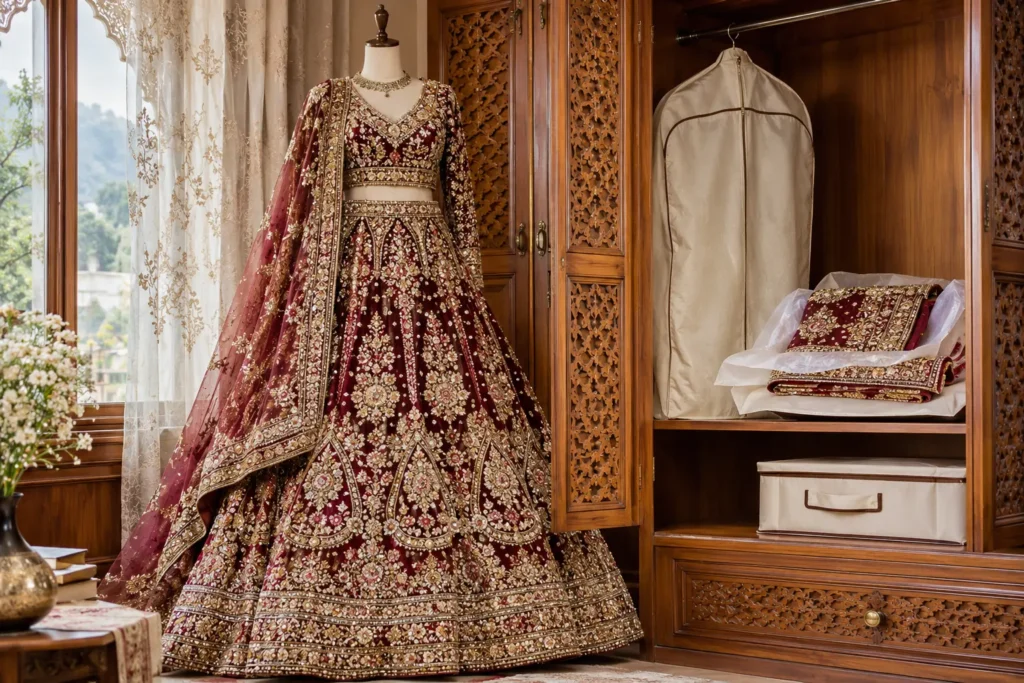
A bridal lehenga may spend just a few hours at the centre of a wedding celebration, but it can remain one of the most treasured outfits in a wardrobe for decades. The problem begins after the wedding. Makeup settles into the neckline, sweat collects around the lining, food stains go unnoticed, and delicate embroidery gets crushed when the outfit is packed away.
If you want to preserve your bridal lehenga for years, what you do immediately after wearing it matters. Heavy zari work, hand-stitched stones, sequins and delicate fabrics all need different levels of care. Simply placing the outfit in a plastic cover and leaving it in a cupboard can put its condition at risk.
For brides and families in Srinagar, where seasonal changes can bring damp storage conditions during colder months, choosing the right cleaning and storage routine is particularly important.
Here is how to care for your wedding outfit without damaging the details that make it special.
Why Do Bridal Lehengas Need Special Care After a Wedding?
A bridal lehenga is rarely made from just one type of fabric or decorative material. A single outfit might combine silk, velvet, net, georgette, metallic threads, sequins and hundreds of individually attached stones.
Each material reacts differently to moisture, friction, heat and cleaning products.
Consider what happens during a typical wedding celebration:
- The neckline comes into contact with foundation, perfume and body oils.
- The blouse lining absorbs sweat.
- The skirt hem picks up dust, food spills and dirt from the floor.
- Embroidered sections rub against jewellery and other fabrics.
- Heavy embellishments experience pressure when the outfit is folded or packed.
Some of this damage is immediately visible. Other problems develop during storage.
For example, a small makeup mark may appear harmless after the wedding but become more difficult to remove if left untreated. Similarly, a loose stone can catch on surrounding embroidery and cause further damage when the lehenga is handled.
The best time to prepare your outfit for long-term storage is shortly after the wedding, before stains settle and small repairs become bigger problems.
1. Inspect the Lehenga Before Putting It Away
Start by examining the entire outfit in natural or bright lighting. Do not assume it is clean simply because there are no obvious stains.
Pay attention to the areas that experienced the most contact during the wedding.
- Neckline and blouse: Look for foundation, lipstick, sweat and perfume marks. These can remain on the fabric even when they are not immediately visible.
- Underarms and inner lining: Sweat and body oils can accumulate here. Check whether the lining has developed an unpleasant smell or visible discolouration.
- Skirt hemline: Long bridal skirts often brush against the floor. Dust, mud, food residue and moisture can collect along the bottom border.
- Dupatta: Examine the edges for makeup transfer, loose sequins and damaged decorative threads.
- Embroidered panels: Check for missing stones, loose beads, broken threads and areas where the embroidery has started separating from the fabric.
If you find loose embellishments, avoid pulling them or trying to remove surrounding threads. Keep the affected area protected until it can be repaired.
A careful inspection helps determine whether the garment needs cleaning, minor repairs or simply suitable storage.
2. Deal With Wedding Stains Before They Become Permanent
Wedding outfits are exposed to more than ordinary household dirt. Makeup, food, oil, perfume and perspiration can all leave marks.
The difficulty is that these stains cannot be treated in the same way.
For instance, foundation and lipstick may contain oils and pigments, while food stains can contain grease, colour and protein-based residue. Applying one household stain remover to every affected area is not a safe approach.
Here is what to watch for:
| Stain type | Common location | Care consideration |
|---|---|---|
| Foundation | Neckline and blouse | Avoid rubbing into the fabric |
| Lipstick | Dupatta and blouse | Oil-based residue needs suitable treatment |
| Food and gravy | Skirt and sleeves | Avoid spreading the stain |
| Sweat | Underarms and lining | Do not leave untreated before storage |
| Perfume | Neckline and shoulders | Avoid adding more chemicals |
| Mud and dust | Lower skirt border | Allow appropriate assessment before cleaning |
What should you do when you discover a stain?
First, avoid scrubbing it with a wet cloth. Do not apply detergent, bleach, baking soda or commercial stain-removal products without checking whether they are suitable for the fabric and embellishments.
If there is a fresh solid spill, carefully lift away the excess without spreading it. Leave the actual stain treatment to someone familiar with delicate garment cleaning.
This is particularly important for heavily embroidered outfits. Rubbing a stain may damage the fabric underneath or loosen stones attached to the affected area.
3. Protect Zari and Zardozi Embroidery From Damage
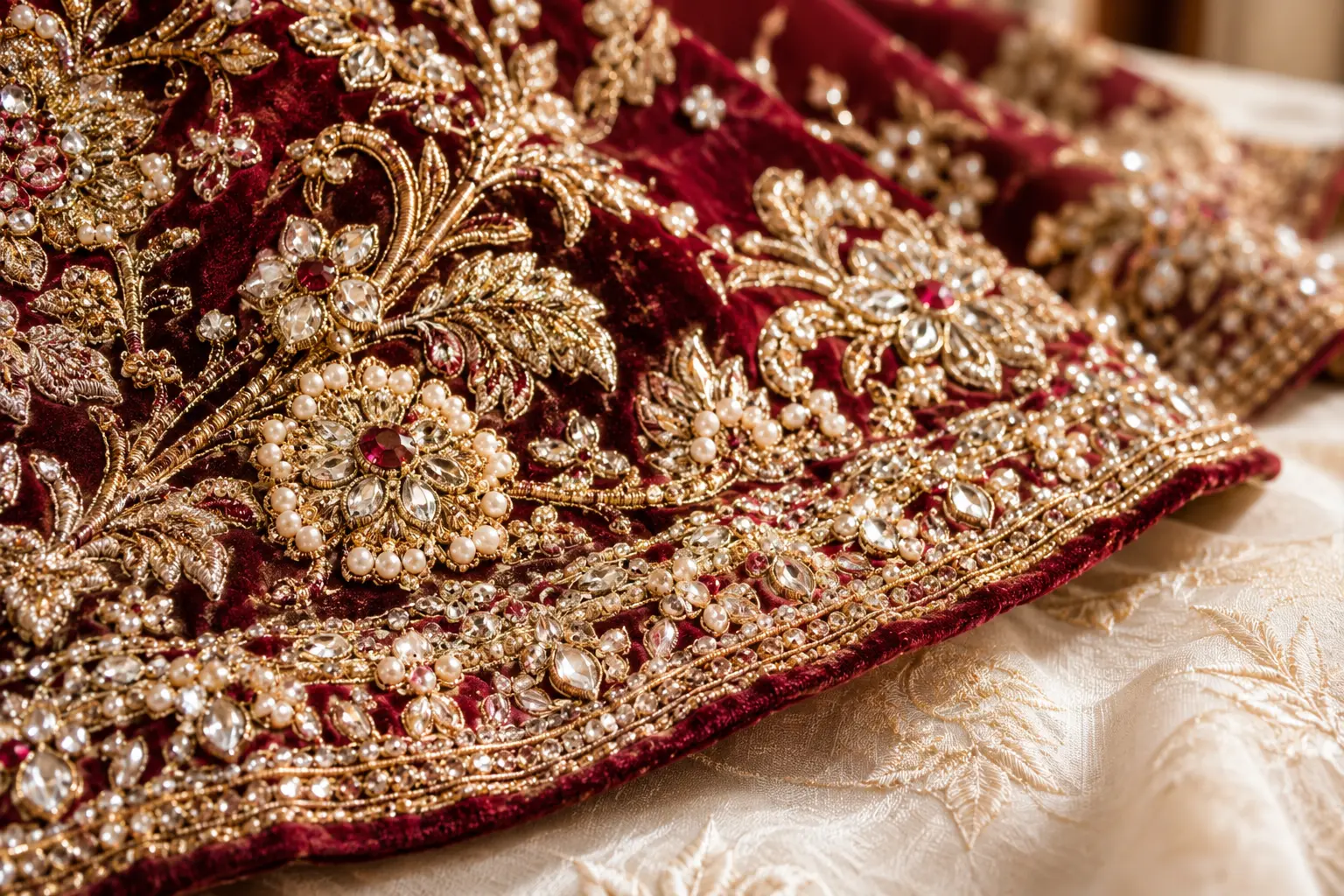
Zari and zardozi work are often among the most expensive details of a bridal lehenga. Their metallic appearance gives traditional wedding outfits much of their richness.
However, metallic embroidery needs careful handling.
Depending on the thread construction and finish, exposure to moisture, unsuitable cleaning products and prolonged friction can affect its appearance. Some metallic threads may also become dull or discoloured over time. Our guide to sozni and tilla embroidery care covers related decorative work.
A few precautions make a difference:
- Avoid spraying perfume directly onto zari embroidery.
- Keep the garment away from damp walls and cupboards.
- Do not use metal polish or household cleaning chemicals.
- Avoid ironing directly over metallic embroidery.
- Never scrub decorative threads with a brush.
- Use soft, acid-free tissue paper to separate heavily embroidered sections during storage.
One mistake worth avoiding is trying to restore dull zari with a household polishing product. Metallic embroidery is not the same as ordinary jewellery, and an unsuitable product may damage its finish or surrounding fabric.
If the zari has already changed colour, have the garment assessed before attempting any treatment.
4. Keep Stones, Beads and Sequins From Falling Off
Stonework can make a bridal lehenga look beautiful, but it also creates one of the most vulnerable parts of the garment.
Many decorative elements are individually attached. Some are stitched, while others may use adhesive or a combination of techniques.
Over time, friction and pressure can weaken their attachment.
Pay particular attention to these situations:
- When folding: Avoid placing sharp creases directly through heavily decorated areas. Repeated folding in the same position can put pressure on the embroidery and surrounding fabric.
- When hanging: A very heavy lehenga may stretch under its own weight, particularly around the waistband and stitched panels.
- When transporting: Do not place jewellery, footwear or other heavy accessories on top of the outfit.
- When handling: Avoid dragging the garment across rough surfaces. Stones and sequins can catch on surrounding materials.
If a few stones have already come loose, have them secured before storing the lehenga. Small repairs are generally easier to address before the garment is packed away for months. See our tailoring and embroidery page for related services.
5. Should You Dry Clean a Bridal Lehenga Before Storage?
This is one of the most important decisions to make after the wedding.
A bridal lehenga that has been worn for an entire celebration may carry perspiration, body oils, makeup residue and dust, even if it looks perfectly clean.
Leaving these residues untreated before long-term storage can create problems later.
Professional cleaning is worth considering when the outfit has:
- Visible makeup or food stains.
- Heavy sweat accumulation around the lining.
- Dirt along the skirt border.
- Delicate silk, velvet or net fabric.
- Extensive zari, stone or beadwork.
- An unpleasant odour after wearing.
However, not every bridal lehenga should automatically undergo the same dry-cleaning process.
The fabric composition, care label, dye stability, stitching and type of embellishment all matter. Some garments may require specialised treatment rather than conventional dry cleaning.
Before handing over an expensive outfit, ask the garment-care provider to inspect the fabric and decorative work.
At Dr Good Day Laundry Service, customers looking for professional laundry and dry-cleaning assistance can explore the available garment-care services. For a heavily embellished bridal lehenga, discuss its construction and cleaning requirements with the team before proceeding.
The objective is to remove accumulated dirt and stains without compromising the garment's original finish.
6. Choose the Right Storage Bag for Your Bridal Outfit
Once the lehenga has been appropriately cleaned, it needs a suitable storage environment.
A common mistake is placing the entire outfit inside the plastic cover supplied by a clothing shop or boutique and leaving it there for years.
Plastic can trap moisture, particularly when the garment has not dried completely or the cupboard itself is damp.
For long-term storage, a clean, breathable cotton garment bag is generally a better choice.
You should also keep the following materials handy:
- Acid-free tissue paper for delicate embroidery.
- A clean cotton sheet for handling the garment.
- A breathable fabric cover.
- A suitable storage box, if needed.
- Separate protective covers for matching accessories.
Avoid wrapping the lehenga in newspaper or coloured paper. Ink and dyes may transfer to delicate fabrics.
The storage material should protect the garment without pressing tightly against the embellishments.
7. Fold or Hang a Heavy Bridal Lehenga?
The answer depends on the weight, fabric and construction of the outfit.
A lightweight lehenga with limited embellishment may be suitable for padded hanging. A heavily embroidered skirt with extensive stonework and zari is often better stored flat or in carefully supported folds.
Hanging a very heavy lehenga for extended periods can place unnecessary stress on the waistband, seams and decorative stitching.
If folding is the better option, follow this approach:
- Clean and dry the garment according to its care requirements.
- Spread it on a clean, flat surface.
- Identify the areas with the heaviest embroidery.
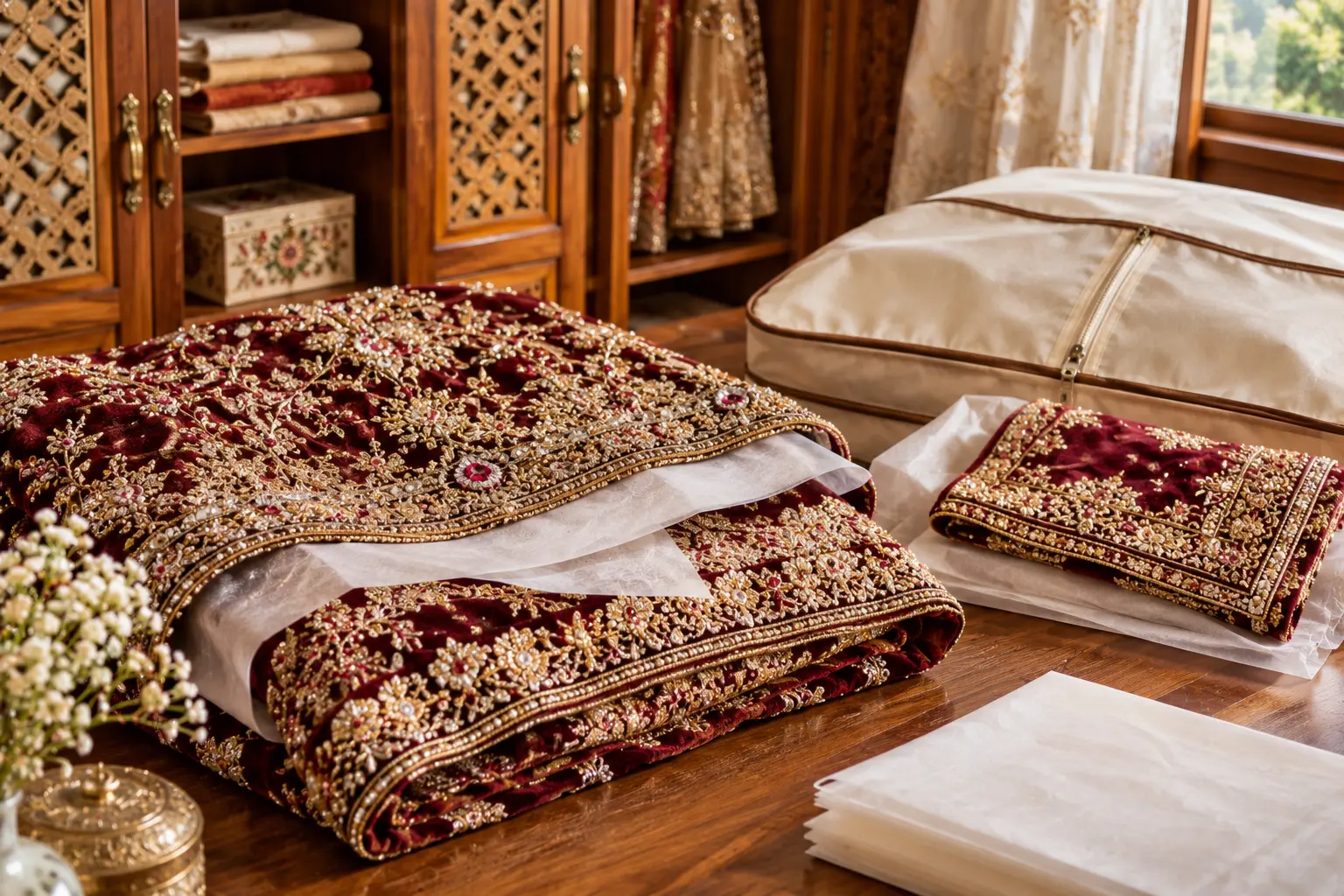
- Place soft acid-free tissue paper between decorated sections.
- Fold loosely, avoiding sharp creases across stones and zari borders.
- Place the garment inside a breathable storage cover.
Do not force the lehenga into a small box or compress it to save cupboard space.
For particularly heavy or intricate outfits, professional advice on storage and support is worthwhile.
8. Store Your Bridal Lehenga Away From Moisture and Sunlight
The location of your storage cupboard can affect how well the outfit ages.
This deserves attention in Srinagar, where seasonal weather changes can make poorly ventilated cupboards and damp storage spaces a concern. The US Environmental Protection Agency's guide to mold and moisture explains why controlling moisture matters.
A bridal lehenga should not be stored against a wall showing signs of dampness or in a cupboard that regularly develops a musty smell.
Choose a location that:
- Stays reasonably cool and dry.
- Does not receive direct sunlight.
- Has no visible signs of moisture.
- Is away from bathroom walls and leaking pipes.
- Does not contain strong-smelling cleaning chemicals.
- Has enough space to prevent the outfit from being compressed.
Sunlight can gradually affect fabric colour, particularly in richly dyed garments. Moisture can encourage mould growth and create unpleasant odours.
If you notice a musty smell, investigate the storage area. Spraying perfume or room freshener will not solve the underlying problem.
9. Store the Blouse, Dupatta and Accessories Separately
The lehenga skirt usually receives the most attention, but the accompanying pieces deserve equal care.
A bridal dupatta may contain fine net, delicate borders and extensive handwork. The blouse may have structured padding, hooks, delicate lining and embroidered sleeves.
Storing everything in one tightly packed bundle increases the risk of friction and damage.
A better arrangement is to:
- Place the dupatta in its own soft protective cover.
- Fold the blouse without crushing its structured sections.
- Wrap heavily embroidered borders with acid-free tissue.
- Keep tassels and decorative latkans from tangling.
- Store matching accessories separately.
- Label the storage covers so individual pieces are easy to locate.
If the outfit includes detachable sleeves, belts or other decorative pieces, keep them together in a separate labelled container.
This makes it easier to retrieve the complete outfit when another occasion arrives.
10. Check Your Bridal Lehenga Every Few Months
Long-term storage does not mean leaving the garment untouched indefinitely.
A quick inspection every few months can help identify problems before they become difficult to manage.
Check for:
- Musty smells or signs of moisture.
- Changes in zari colour.
- Loose stones and beads.
- Broken embroidery threads.
- New stains or discolouration.
- Damage to the storage bag.
If the garment needs inspection, handle it with clean, dry hands and avoid unnecessary unfolding.
Pay attention to the storage cupboard as well. A clean, dry outfit can still develop problems if its surroundings are damp.
Common Mistakes That Can Ruin a Bridal Lehenga
Even careful owners sometimes damage their wedding outfits through small storage mistakes.
Here are some practices to avoid:
| Mistake | Possible consequence |
|---|---|
| Storing without checking for stains | Residue may become harder to remove |
| Using plastic for long-term storage | Moisture may become trapped |
| Hanging an extremely heavy lehenga | Stretching around seams and waistband |
| Folding directly over stonework | Pressure on delicate embellishments |
| Applying perfume to zari | Possible damage to metallic finishes |
| Using household stain removers | Colour changes or fabric damage |
| Ignoring loose beads | Further damage during handling |
| Storing in a damp cupboard | Musty odours and potential mould growth |
A wedding outfit is an expensive garment, and repairing damaged embroidery can be difficult. Avoiding these mistakes is far easier than trying to reverse the damage later.
Next Steps: Protect Your Bridal Lehenga Before Storing It Away
Your wedding outfit deserves more attention than an ordinary garment. Whether you plan to wear it again for a family celebration, pass it down or simply keep it as a reminder of your wedding day, the way you store it now will affect its condition in the future.
Before putting it away, check for hidden stains, inspect the embroidery and make sure the fabric is completely dry. If the outfit has delicate zari, extensive stonework or difficult stains, seek professional garment-care advice rather than experimenting with home cleaning products.
For professional laundry and dry-cleaning assistance, visit Dr Good Day Laundry Service and explore the available services at DrGoodDay.com.
Taking care of your bridal lehenga today means giving those wedding memories a better chance of lasting.
Dr. Good Day Luxcare Studio offers laundry and dry cleaning in Srinagar with doorstep pickup and delivery.
Book a Pickup WhatsApp UsQuestions? Contact us or see our full services list.
Frequently Asked Questions
1. How can I preserve my bridal lehenga for many years?
Have the garment inspected and cleaned according to its fabric and embellishments. Allow it to dry completely, protect embroidered sections with acid-free tissue paper and store it in a breathable cotton cover in a cool, dry cupboard.
2. Can I store my bridal lehenga in a plastic bag?
Plastic covers are not ideal for prolonged storage because they can trap moisture. A clean, breathable cotton garment bag is generally a better choice, particularly when storing delicate fabrics and heavy embroidery.
3. How do I prevent zari embroidery from turning dull?
Keep zari away from moisture, direct sunlight, perfumes and harsh cleaning products. Avoid rubbing or polishing metallic threads. Store the garment carefully with acid-free tissue paper separating embroidered sections.
4. Is it safe to wash a bridal lehenga at home?
Home washing is not recommended for heavily embellished bridal outfits unless the care instructions specifically permit it. Water, detergents and rubbing can damage delicate fabrics, metallic threads and attached stones. Professional assessment is the safer starting point.
5. How often should I inspect a stored bridal lehenga?
Check the garment every few months for moisture, unusual odours, loose embellishments and discolouration. Also inspect the cupboard and storage cover to ensure the environment remains clean and dry.